|
2–3 Hours 50–150 Participants 16+ Volunteers 2,000+ Sq. Ft. In-Person Format Why a Simulation?Poverty is a reality for many individuals and families. But unless someone has experienced poverty, it can be difficult to fully understand the daily stress, limited choices, and structural barriers that shape people's lives. The Poverty Simulation helps bridge the gap from misconception to understanding. Participants step into realistic family situations and experience how transportation, employment, child care, school, food, housing, health, and access to services are deeply connected. The goal is not to "play poverty." The goal is to create a shared learning experience that builds empathy, challenges assumptions, and opens the door to deeper conversations about local change. What the Simulation Helps Participants DoParticipant Reflection "This simulation gave me a whole new perspective, a greater appreciation for the choices she has made and an increased respect for my little sister, and for those just like her." — Poverty Simulation participant with a sister in poverty How the Poverty Simulation WorksDuring the simulation, participants take on the identity of someone experiencing poverty and work together with their assigned family to navigate a simulated month. 1 OrientationParticipants and volunteers receive instructions and are introduced to the simulation structure. 2 Family RolesParticipants are assigned to families with realistic circumstances, responsibilities, and needs. 3 Four Simulated WeeksFamilies move through four 15-minute "weeks" while trying to meet basic needs. 4 Community ServicesFamilies interact with schools, banks, employers, grocery stores, service providers, and other community resources. 5 DebriefParticipants reflect on what happened and discuss what poverty means for individuals, families, agencies, and communities. What Happens During a Simulation? Meet Ann Aber. Like many people experiencing poverty, Ann faces the daily struggle to keep a roof over her head and her children fed. Ann is one person in the group of up to 26 families represented in the Poverty Simulation. Participants may need to get to work, pay rent, care for children, attend school, buy food, manage health issues, access services, and respond to unexpected challenges. The experience helps participants see how quickly one barrier can affect every other part of a family's life. Again, the simulation is not a game. It is based on the stories of real Community Action clients. 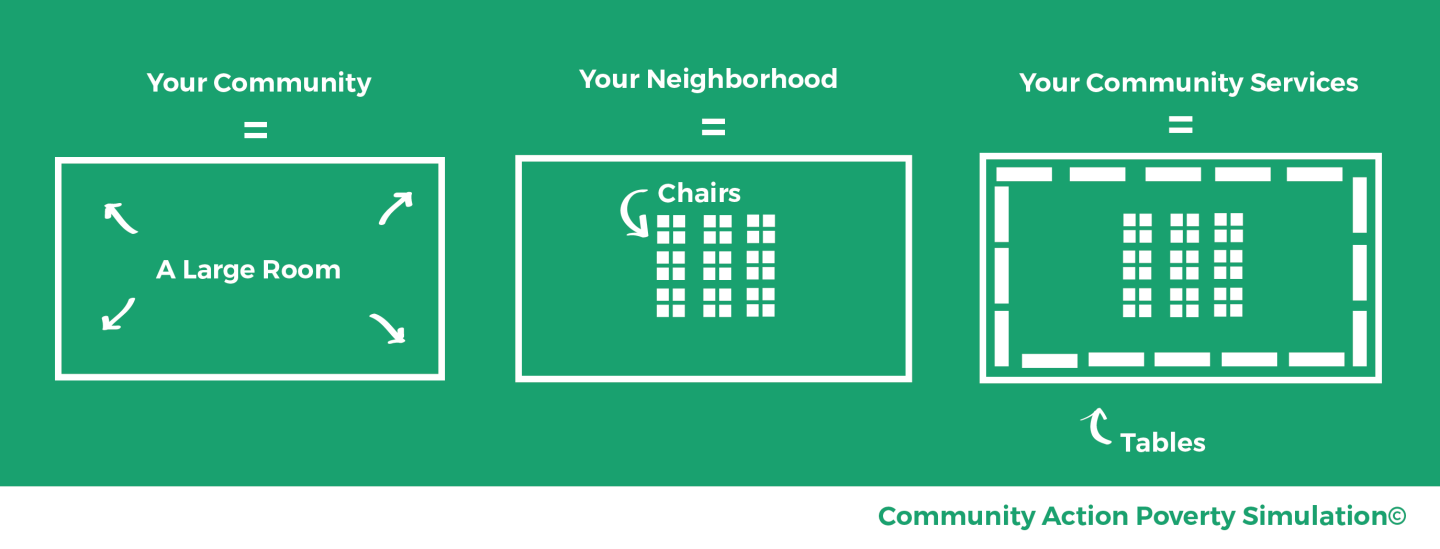
The room represents the community. Family homes are represented by chairs in the center of the room. Community services and businesses are represented by tables around the perimeter. Who Should Host or Attend?The Poverty Simulation is valuable for organizations and groups that want to build awareness, strengthen empathy, and better understand how poverty affects families and communities. Community Action Agencies Nonprofit Organizations School Districts and Colleges Health Care Organizations Boards of Directors Elected Officials and Local Leaders Faith-Based and Community Groups Staff Development Teams What Others Have SaidCommunity Action"We love the poverty simulation because it offers a truly meaningful, insightful experiential learning opportunity for the participants. It is one of our most powerful tools for reframing issues of poverty." Afron January, Community Action Partnership of Utah Nonprofit Organizations"The Poverty Simulation has motivated and inspired many of our participants to take action in our state. This has been one of the best tools we have found to begin the conversation and take action." MaryLou Beaver, Every Child Matters Education"As we incorporated this training into our Induction Seminars we provided to our new teachers, it became clear that it was a complete eye-opener for many of them." Dr. Donna Smith, Beaufort County School District Planning a Poverty SimulationNYSCAA Provides
Host Site Provides
What Participants Walk Away WithGreater empathy for families experiencing poverty and crisis. Better understanding of structural barriers and limited choices. Stronger awareness of how housing, food, transportation, work, school, and health are connected. A shared foundation for deeper community conversation and action. Frequently Asked QuestionsIs this an online simulation?No. The Poverty Simulation is an in-person, facilitated learning experience. How long does it take?The full event typically takes about 2 to 3 hours, including orientation, the simulation, and debriefing. How many people can participate?The simulation works best with approximately 50 to 150 participants. How many volunteers are needed?At least 16 volunteers are needed. For simulations with more than 100 participants, 24 volunteers are recommended. What kind of room is required?A large room of at least 2,000 square feet is recommended. A high school gym or similar space is ideal. How do we schedule one?Contact NYSCAA to discuss your audience, space, preferred timing, and planning needs. Bring the Poverty Simulation to Your Organization Start the Conversation. Build Understanding. Inspire Local Change.NYSCAA can work with your agency or organization to plan a Poverty Simulation that fits your audience, available space, and learning goals. |

Strengthening New York's Community Action network to address the causes and conditions of poverty.
Accessibility Support
NYSCAA is committed to improving accessibility across our website and digital content. For assistance, contact [email protected] or 518-690-0491.
Quick Access
© Copyright 2026 NYSCAA. All rights reserved.